Arriving at the place of the tragedy and encountering a reality much harsher than what the first images had shown. Listening for an hour to the account of a family. Sitting in front of people who had lost their home, their job, or their loved ones. And discovering, amidst the rubble, small signs of hope.
This is how Marcus Tullius described, during the meeting of the Latin American and Caribbean Ecclesial Communication Network (Reclac), the experience he lived for a week in Venezuela, where he arrived a few days after the earthquakes that affected the country.
The communicator acknowledged that he needed time to process what he experienced. “It was very hard for me to process everything I saw, lived, and felt in Venezuela,” he expressed. The experience was so intense that, as he recounted, during the return trip from Brazil to Chile he faced an unexpected difficulty: “I was left like a communicator without words in front of everything I saw”.

A scene that looked like a war zone
He managed to put in writing what he experienced and published a testimony about his experience as a field communicator. The text, he explained, was published thanks to the Celam team and aimed to show a reality that, from his perspective, far exceeded what he had been able to know through initial reports. “What I saw in the field was like 10, 20 times more” than what had initially reached him through the information known in Brazil, he noted.
Tullius recounted that he arrived at ground zero approximately 30 days after the earthquakes. There, in front of completely destroyed buildings, he experienced a silence that he described as a contemplation provoked by the magnitude of the tragedy. “I was left in a silence of contemplation because I was at a loss for words,” he recalled.
The collapsed buildings, the people who remained in the area, and the conditions of the ground formed, in his words, “a war scene.” The impact was not only visual. It was also influenced by the environment and by the smell that lingered in the area.

The presence of God in the midst of suffering
“It took me like two days to get out” of that experience, he recounted. Even with masks, the smell lingered. During the first day he lost his voice and began to feel pain in his throat.
But in the midst of that experience of helplessness, he also found gestures that, for him, expressed “the small signs of God in this space of so much tragedy”.
One of those signals appeared in the words of those who approached the communicators: “Thank you for coming. Thank you for listening to me. I needed to vent”.

Listen before asking
One of the moments he recounted as significant was the encounter with a woman who asked to speak, but who initially did not want to be recorded. Tullius shared that three journalists —María Eva, himself, and an American colleague who worked on the ground— stayed for about an hour in the woman’s house, simply listening to her.
The woman recounted the seconds she lived through during the earthquake, which felt eternal, together with her husband and her son, a non-verbal autistic child. In the midst of the emergency, she recalled, her only reaction with her husband was to hold each other to protect themselves. The woman then expressed a phrase that remained etched in the communicator's memory: “I cannot die”.
For Tullius, that testimony revealed a dimension of the tragedy that does not always appear in the numbers: the fear and responsibility of those who feel that they do not even have the right to think of themselves because they must stay to protect and accompany others. “A striking experience, I believe it is the most brutal I have ever had as a communicator, as a human being,” he said while recalling that week.

Solidarity as a response
Along with the pain, Tullius highlighted the response capacity and resilience of the Venezuelan population. He also valued the presence of the Church and, particularly, of Caritas, in the context of a complex political and social situation.
According to he explained, Cáritas has support from both the government and sectors of the society and, due to the work developed during the last years amid the humanitarian crisis, was able to begin responding just 12 hours after the tragedy.
On the morning of Thursday, June 25, Cáritas was already active alongside the diocesan and parish structures, supporting the population through the distribution of food, water, hygiene kits, and other supplies. Tullius explained that, within Cáritas, the member organizations activate their networks based on the call from the national Cáritas of the affected country. It is the national organization that coordinates the response, mobilizes the others, and requests the necessary support. In the Venezuelan case, Cáritas Venezuela took on that coordination.
“After the tremor, love”
As part of the response, Cáritas Venezuela activated the campaign “After the tremor, the love”, an initiative that was also taken on by Cáritas Latin America. Tullius shared during the meeting some of the figures corresponding to the first month of response: 21 tons of aid received and 86% of those resources already distributed. He also reported that 22,900 families had received a complete kit with food, water, and hygiene items, in addition to medical supplies, medications, and other materials..
The campaign remains active and includes various forms of collaboration. Some countries have opted to hold collections in their communities, while others develop permanent financial campaigns.
For Tullius, communication has a decisive task here: to prevent the tragedy from disappearing from the agenda once the first weeks pass. “This happens in all tragedies: in the first days everyone is talking. In the second, the third, in the fourth week it drops until no one talks about Venezuela anymore and we cannot not talk,” he warned. Reconstruction, he recalled, will be long. In the framework of Caritas an emergency response of at least a year and a half is contemplated for the application of funds and to begin to think about reconstruction.
Emergency with multiple dimensions
The complexity of the Venezuelan situation became even more evident for Tullius during his time on the ground. According to him, technicians from Caritas from Germany, Spain, and the United States who had previously participated in humanitarian responses, even in the 2010 earthquake in Haiti, considered that the situation found in Venezuela was especially complex.
The emergency, he explained, does not only affect those who lost their homes. There is also a population that lived in poverty around the most affected areas and depended on them for work. People who worked at the airport, hotels, clubs, and casinos were left unemployed due to the paralysis of those activities.
In addition, the environmental dimension is added. Tullius recounted that he was able to observe how, in the coastal area, the remains of the collapsed buildings were being moved to the sea. “So, beyond the entire complex of poverty, there is also the environmental problem”, he pointed out, especially due to the consequences for the lives of the fishermen who live in the area. The communicator described the impact of seeing buildings completely collapsed, with their floors stacked like a compressed structure, while rescue teams worked to identify and facilitate search efforts.

The call from Father William Costa: “Do not forget us”
During the meeting, Father William Costa from Venezuela also spoke, sharing from a personal experience marked by tragedy. “I believe that the support we have received from the entire Latin American Church has been very significant”, he expressed.
For the priest, the response received demonstrates that the Church can walk alongside a suffering people. “We are a synodal Church that at this moment also walks with a suffering people”, he said.
Father Costa shared that he himself was affected and lost a family member. He also recounted that work colleagues were left without housing and belongings, so the response of the Church must consider not only the material needs but also the human accompaniment.
From his experience in the educational field, he also announced the project of volunteer teachers, aimed at bringing educators to the shelters where the affected families remain.

Emergency education to support children and adolescents
The Venezuelan priest explained that approximately 200 buildings collapsed during the earthquake and that more than 20,000 people and families were affected. In addition, there are more than 200 shelters that receive families who for a time will have to stay in tents or educational spaces.
Behind those figures is a child and adolescent population that needs specific attention. “A population of boys, girls, and adolescents who do not understand anything of what is happening and who of course also need to be accompanied”, he pointed out.
For the priest, this emergency highlighted a need that should challenge the entire Latin American Church: the training of teachers to respond in emergency contexts. “We need to train our teachers for emergency education”, he expressed, emphasizing that teachers must be present alongside doctors, journalists, and other professionals to accompany a population that is considered especially invisible.
He also warned about other risks that arise in disaster contexts, including human trafficking and the trade of people. He mentioned the disappearance of adolescents and clarified that, although there are suspicions that some may have fallen into trafficking networks, they do not have evidence to prove it.

Crisis that may prolong
Father Costa insisted that the emergency cannot be analyzed in isolation. In addition to the devastation caused by the earthquakes, there is a political, economic, and social crisis that exacerbates the difficulties of recovery.
He also recounted the experience of his own family and noted that the institutional response for searching for people did not arrive as quickly as expected. In that context, he emphasized that the Church was present from the very first moments: “The Church was there before civil protection, before the firefighters, before the police”.
Beyond the political assessments expressed during his intervention, Father Costa closed with a call focused on solidarity and communication: “To ask you not to forget us, that we are not just a news story.” His request summarizes one of the main challenges posed during this space of the Reclac: that the communication should not only accompany the most visible phase of an emergency, but should remain when the cameras withdraw and the long process of reconstruction begins..
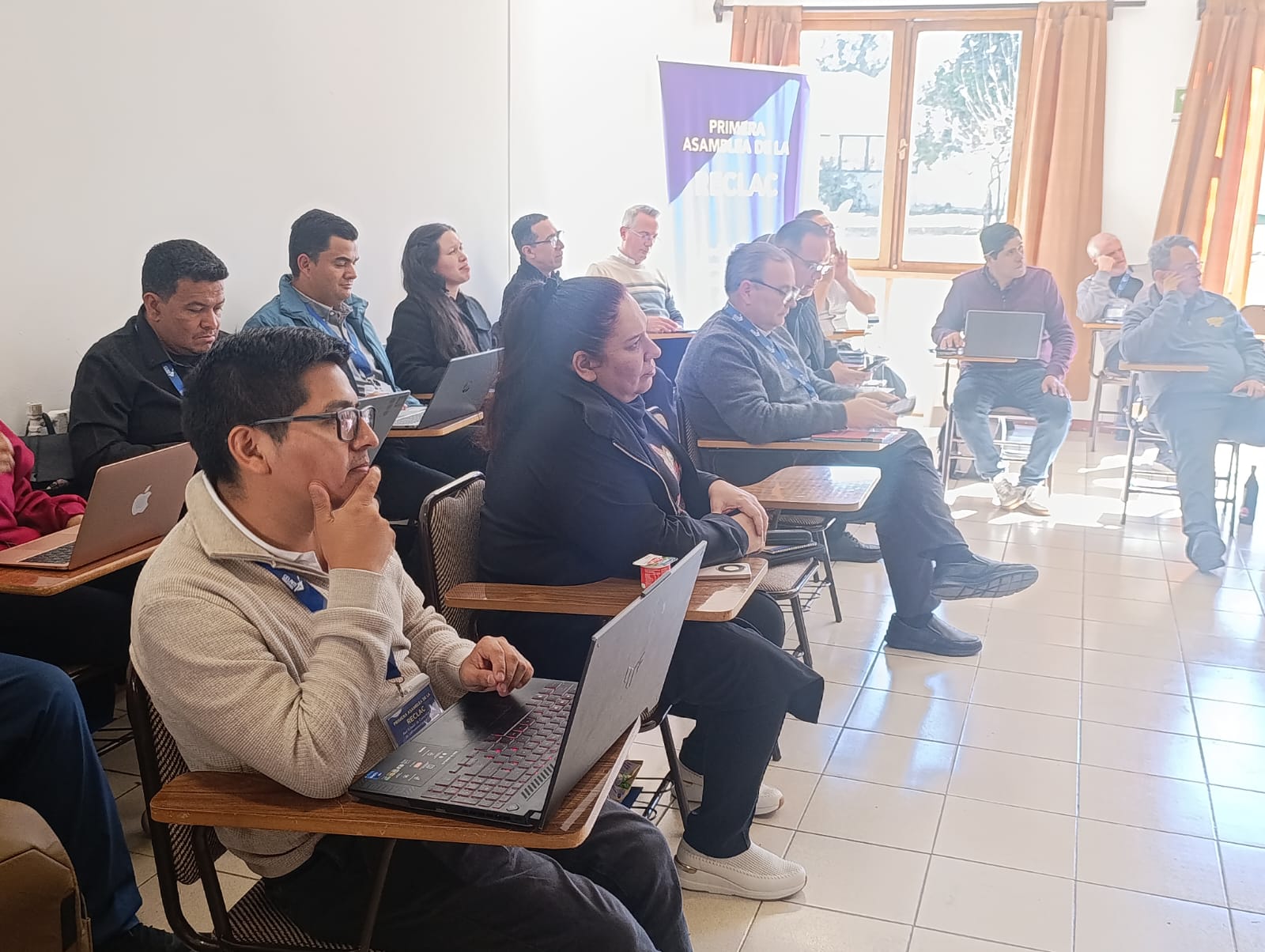
Communicate when the news stops being trending.
For Tullius, keeping attention on Venezuela also requires understanding the difficulties faced by the communicators themselves and the organizations that work on the ground. During the emergency, he explained, the conditions of connectivity were especially complex. The team even used four Starlink antennas and, even so, at times the photographs and videos taken during a day could only be sent the next day.
The communication was also coordinated with the local team of Cáritas Venezuela and with the press office of the episcopal conference. The very structure of communication was also affected: one of the members of the communication team had lost her home, while other workers were left without housing or employment.
In this context, Cáritas Latin America continues to collect and distribute audiovisual materials —photographs and videos— produced with the support of the local team of Cáritas Venezuela. Tullius explained that this content is free to use and can be utilized by communicators from different countries to inform and mobilize solidarity. He also highlighted the importance of strengthening national campaigns, especially because the possibilities to donate internationally may be limited by the banking conditions of each country. Local campaigns allow people to contribute in their own currency and for the resources to be transferred to Venezuela later.
Press that accompanies, but begins to withdraw
During the dialogue with the participants of the Reclac, a question also arose about the role of the media in the face of the tragedy and whether the coverage had been collaborative, sensationalist, or influenced by the Venezuelan political context.
From his on-the-ground experience, Tullius considered that, in general terms, the local and international press had collaborated in the coverage. He recounted that he had contact with journalists and teams from international media whom he described as collaborators and concerned about showing the reality.
However, he warned that the problem arises when media attention decreases. “In the first two weeks they were fully engaged. From the third week onward, it started to decrease significantly,” he explained. He also observed a reduction in the presence of foreign journalists in the territory.
That people and their stories do not become invisible
For the communicators gathered at the Reclac, this scenario raises a crucial question: how to continue telling an emergency when it stops being news? The shared experience of Tullius and Father Costa points to one answer: to maintain the gaze, listen to the stories that remain after the first news, accompany the solidarity campaigns, and use communication as a tool so that affected people do not become invisible.
Because, as Father William Costa reminded from Venezuela, the challenge now is that the country does not become a passing news story. “Do not forget us”, he asked. And behind that phrase appears a concrete task for Latin American ecclesial communication: to continue telling what happens when the rubble remains, the shelters keep filling up, and the reconstruction barely begins.
Subscribe for free to our Whatsapp channel https://bit.ly/4hbWWN0
Discover the new 2026 offer of courses, diplomas, and degrees at Cebitepal https://bit.ly/4aHAue1
Because we must care for those who protect creation, the podcast La Vida pende de un Hilo arrives https://bit.ly/46cGUiB