In the face of new realities of human mobility, the Church is called not only to welcome but also to accompany, defend rights, and open paths to integration. This perspective was present in the interventions of Amaya Valcárcel, Álvaro Botero, and Alessandra Santopadre at the closing of the webinar series “Human mobility and human rights: a perspective from hope.”
The meeting, titled “A renewing voice: good pastoral practices of the Church in defending the human rights of migrants”, gathered experiences from different contexts of human mobility in Mexico, Cambodia, Panama, and Canada, highlighting pastoral accompaniment and the defense of rights.
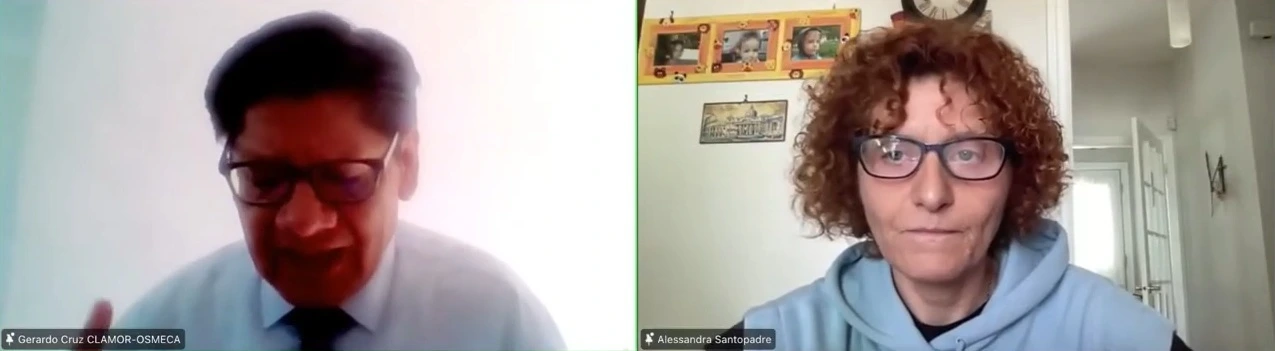
This webinar session was organized by the Latin American and Caribbean Episcopal Council (CELAM) in collaboration with Red Clamor, the Central American Observatory on Human Mobility (OSMECA), the Hopeborder Institute, the Dicastery for Integral Human Development, and the Archdiocese of Montreal (Canada). Gerardo Cruz, of OSMECA and Red Clamor, moderated the discussion.

Staying close to those who wait
Waiting as a new stage of human mobility was one of the axes raised by Amaya Valcárcel, from the Dicastery for the Promotion of Integral Human Development. “The journey is not over, it has simply changed. It is no longer the journey of kilometers, it is the journey of waiting”, he expressed.
Starting from experiences developed in Mexico, Cambodia, and France, Valcárcel identified three verbs that, in his opinion, can guide pastoral action: “to stay, to rebuild, and to belong”. In Mexico, he explained, many migrants spend months in a “legal” and human limbo that makes it difficult to project their future.
“Before starting a project, one must listen,” Valcárcel pointed out, warning that the migrant cannot be reduced to a file. Listening allows us to recognize “a profession, a story, a family, a culture, a faith, abilities, and dreams.”
The experience in Battambang, Cambodia, demonstrates a pastoral approach that does not stop at initial reception but continues to support people until they regain their autonomy, livelihoods, and ability to rebuild their lives.

The defense of rights needs alliances
From his experience in Panama, Álvaro Botero, consultant and researcher at American University, United States, showed how the articulation between lawyers, civil society, and the Church allowed for the activation of protection mechanisms and to undertake actions in defense of asylum seekers.
Botero highlighted that the Church contributed much more than humanitarian assistance: it created the necessary conditions to document the facts and advance legal actions. “The legal work I just described would not have happened without the support of the Church,” he pointed out.
For Botero, these conditions were fundamental for legal defense: “You cannot build trust that requires an interview with someone who is still in survival mode.”
“Presence comes before paperwork,” he emphasized. And he summed it up: “In Panama, the law established the mechanisms, but the Church provided the foundation on which people could stand while justice was sought for them.”
Integrate to prevent exploitation
For her part, Alessandra Santopadre highlighted integration as an essential component of the protection of migrant people. “Integration is not a luxury that comes after the emergency. It is what turns welcome into a dignity sustained over time,” said the representative of the Office of Cultural and Ritual Communities of the Archdiocese of Montreal.
The pastoral model of Montreal bets on a close and territorial presence, alliances with specialized organizations, support in the mother tongue, and training of pastoral agents, without neglecting political advocacy to address the causes of exploitation.
The prevention of trafficking and exploitation also begins by breaking isolation, said Santopadre. His proposal for dioceses and parishes includes leveraging existing networks, concentrating efforts where there are greater risks, and training pastoral agents capable of early detection of these situations.
Santopadre concluded his intervention by advocating for a comprehensive view of care for migrant people. Based on the four verbs of Pope Francis —welcome, protect, promote, and integrate— he stated that protection and integration must move forward together: “They are the same movement.”
Subscribe for free to our Whatsapp channel https://bit.ly/4hbWWN0
Discover the new 2026 offer of courses, diplomas, and degrees at Cebitepal https://bit.ly/4aHAue1
Because we must care for those who protect creation, the podcast Life Hangs by a Thread arrives https://bit.ly/46cGUiB
Discover the new 2026 offer of courses, diplomas, and degrees at Cebitepal https://bit.ly/4aHAue1
Because we must care for those who protect creation, the podcast Life Hangs by a Thread arrives https://bit.ly/46cGUiB