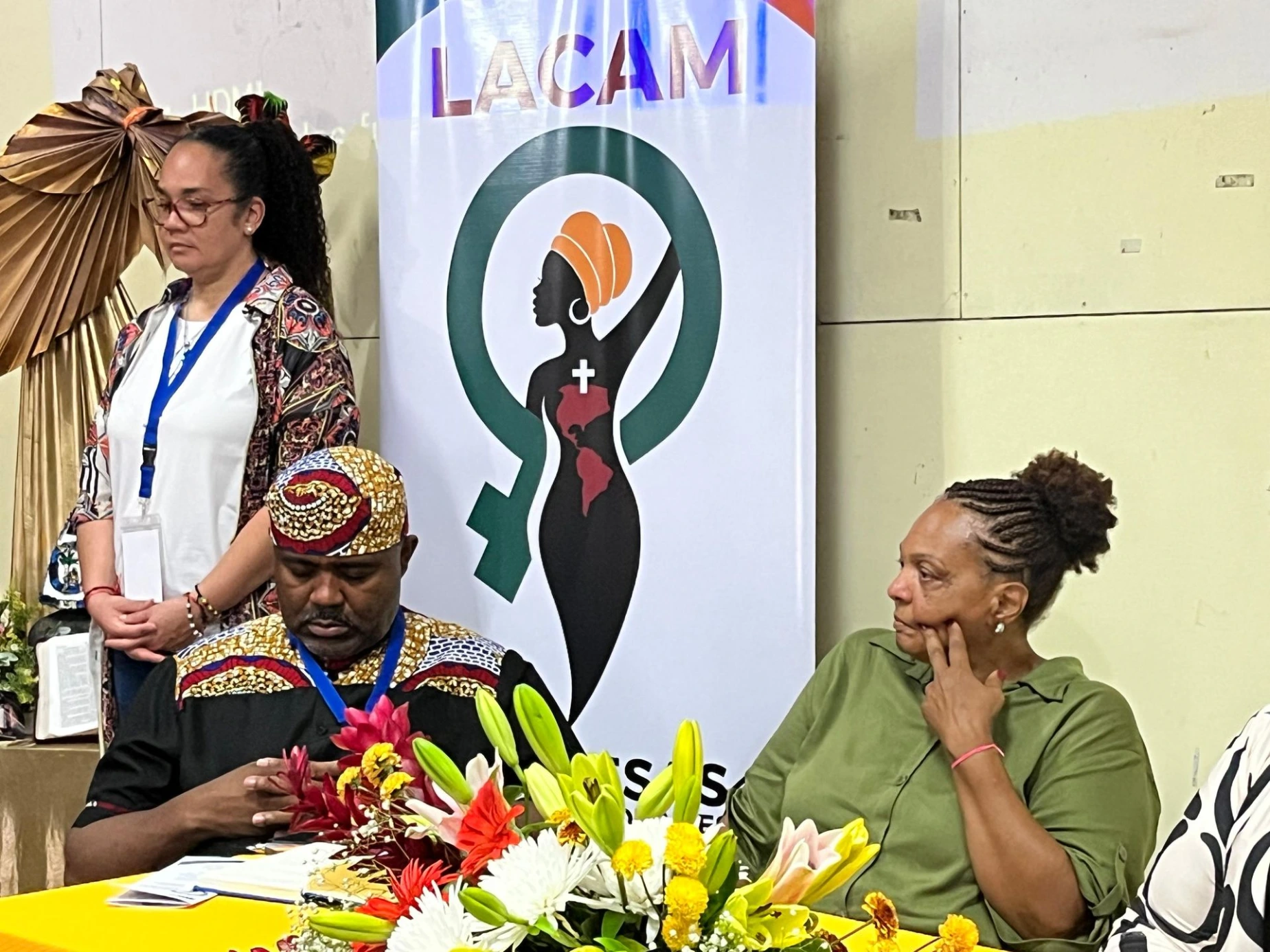
The need for Afro-descendant women to have effective participation in decision-making spaces of the Church was one of the main challenges identified during the meeting of Afro-Latin American and Caribbean Women (Lacam) 2026. This was pointed out by Támara Barbará, a member of the coordinating team of the Network of Afro-Latin American and Caribbean Leaders, when making a review of the dialogue and work sessions held during the meeting.
The participants addressed different realities of Afro-descendant communities, from racism and discrimination to inclusion and education. One of the axes of reflection was also the encyclical Magnifica Humanitas by Pope Leo XIV, particularly from the perspective of Catholic Afro-descendant women.
Barbará explained that the papal document was read as an opportunity to recognize a history marked by exclusion and to move towards a more equitable society. “This perspective, this message from the Pope (...) is a fundamental historical reparation for our Afro-descendant people,” she said, highlighting the importance of interpreting this message from the concrete experience of Afro-Latin American and Caribbean women.

“It is important that the voice of women is represented by us”
One of the consensuses that ran through the conversations was the need to expand the spaces for the participation of Afro women within the Church. Barbará pointed out that communities have women who sustain pastoral life and the transmission of faith, but that presence is not always reflected in the places where decisions are made. “If we embrace so much and love so much our Church, it is important that the voice of women in the first person is always represented by us”, she expressed.
The leader explained that the demand is to ensure that Afro-descendant women themselves can participate in the construction of proposals and decisions that affect their communities. She considered that when other people interpret their needs, there is a risk that their true demands become partially diluted.
In this sense, the meeting aimed to move from identifying problems to developing proposals and building an action plan that allows the network to continue articulating its efforts in different countries..
Education and cultural identity, another challenge.
For Barbará, it is necessary to promote educational models that allow children, girls, and young people to know and value the history and cultural identity of Afro-descendants. “Without education, we will not have the other leg of this table”, she pointed out, raising the need to promote an education that incorporates the experiences, cultures, and contributions of Afro-descendant peoples.
From this perspective, music, culture, and Afro traditions should not be associated with negative stereotypes or a source of shame. On the contrary, she argued that they should become sources of identity and pride for the new generations.
The reflection also included the need for better statistics on Afro-descendant populations. Barbará explained that the absence of data makes it difficult to make certain situations visible and limits the possibility of designing public policies that are appropriate to the needs of these peoples.
Network that wants to articulate diverse realities
The participants of the meeting come from countries with different histories, social contexts, and pastoral experiences. For Barbará, this diversity constitutes one of the riches of the network. The challenge is to find points of convergence without disregarding the particularities of each region. The networking work allows, as she explained, to identify common issues and, at the same time, to build responses that take into account local realities.
Among the shared concerns, she also mentioned the situations affecting children, adolescents, and young Afro-descendants. She questioned the stereotypes that reduce these realities to crime or addiction and called to look at the social conditions that generate exclusion.
In this context, she considered that the articulation between the leaders and the pastoral processes can become a tool to support the communities and promote more comprehensive responses.
From invisibility to planning
For Barbará, the meeting represents the culmination of a process that began to be developed more than a decade ago. He recalled that the idea of holding a first in-person meeting of this nature emerged more than ten years ago and that the network has gained greater consolidation in recent years.
The Lacam 2026 meeting appears as a destination point, but also as the beginning of a new stage. “Everything is possible”, he stated when valuing the path taken and the possibilities that open up for afro-descendant women. In his opinion, there is an important change in the way of framing the struggles of afro-descendant peoples. For a long time, he explained, the starting point was to demonstrate that they existed, to make their realities visible and to denounce situations of exclusion.
“We always started as afro-descendants from the premise that we do not exist, that we are not visible, that nothing is created for us”, he said. Now, he believes that the challenge is to move towards a new question: what do they want to build and how do they want to do it. “We are on the threshold of being visible (...) we are in the context of organizing ourselves and planning what we want moving forward”, he stated.
Subscribe for free to our Whatsapp channel https://bit.ly/4hbWWN0
Discover the new 2026 offer of courses, diplomas, and degrees at Cebitepal https://bit.ly/4aHAue1
Because we must take care of those who protect creation, the podcast La Vida pende de un Hilo arrives https://bit.ly/46cGUiB