
In immigration matters, governments must seek a middle ground, because “it is not about choosing between security and humanity, but finding the point where both mutually support each other,” suggests Alessandra Santopadre from the Archdiocese of Montreal (Canada), in an interview with ADN Celam.
Esta laica, quien es asistente de la Oficina de Comunidades culturales y rituales de la arquidiócesis de Montreal, será panelista, este 27 de agosto de 2026, en el conversatorio “Una voz renovadora: buenas prácticas pastorales de la Iglesia en la defensa de los derechos humanos de las personas migrantes”, organizado por el Celam y organizaciones eclesiales.
She stated that migration “is not a problem to be solved, it is a human reality to accompany,” because from her experience as a pastoral agent, she sees the concrete face of that phenomenon every day: families, stories, hopes, and “also a lot of pain,” she added.
For this reason, she firmly believes that the greatest challenge for the Church, for governments, and for civil society is orderly but compassionate immigration policies, real cooperation with the countries of origin.
All of this so that “migration is an option and not an obligation, and a constant and brave denunciation against those who violate human rights, whether through direct violence or political indifference.”
In the end, – indicates Santopadre – as a Church, “our task is very simple to name and very demanding to live: to welcome, protect, promote, and integrate. And we do this convinced that in every migrant person there is a sacred story that deserves to be heard, not silenced.”
In the end, – indicates Santopadre – as a Church, “our task is very simple to name and very demanding to live: to welcome, protect, promote, and integrate. And we do this convinced that in every migrant person there is a sacred story that deserves to be heard, not silenced.”
As a Church, “our task is very simple to name and very demanding to live: to welcome, protect, promote, and integrate.
A structural phenomenon
Question.- From your experience in the office of cultural communities of the Archdiocese of Montreal, how do you describe the migratory phenomenon not only in Canada but in North America?
Answer.- From my daily work in the office, I see that migration in North America is no longer a situational phenomenon, but structural. We are talking about a migratory corridor that goes from Central America, the Northern Triangle, Haiti, and Venezuela, to the United States and, increasingly, Canada.
In Montreal particularly, we have seen a notable increase in asylum seekers in recent years, many of whom arrive after having first crossed through the United States. This has tested our capacity to welcome: housing, health services, linguistic integration, everything has been demanded.
But beyond the numbers, what I see day by day are human stories: families who left everything due to violence, economic collapse, climate crisis, or lack of future in their countries. And I think it is important to say it clearly: as long as those underlying causes are not addressed, this phenomenon will continue to grow, no matter how many restrictive measures are implemented.
Neither numbers nor problems to solve
Q.- What advances or contributions can you mention from the Church's work in this regard?
R.- The Church has played a fundamental role in direct accompaniment. In our office, for example, we offer shelter, basic guidance, psychosocial support, and, above all, spaces where migrant communities can maintain their cultural and religious identity while integrating into Canadian society.
We have catechesis in several languages, liturgical celebrations that respect the traditions of each community, and networks of mutual support among the migrant communities themselves.
There is also public advocacy work: the Church constantly reminds us, in a context where fear-based discourse sometimes prevails, that we are talking about people with dignity, not numbers or 'problems' to be solved. And there is very valuable ecumenical and interreligious work, with shelters, food banks, and collaboration with other faiths and civil organizations that share this mission of welcome.
There is also public advocacy work: the Church constantly reminds us, in a context where fear-based discourse sometimes prevails, that we are talking about people with dignity, not numbers or 'problems' to be solved. And there is very valuable ecumenical and interreligious work, with shelters, food banks, and collaboration with other faiths and civil organizations that share this mission of welcome.
The Church constantly reminds us, in a context where fear-based discourse sometimes prevails, that we are talking about people with dignity, not numbers or 'problems' to be solved.
Regulate with humanity
Q.- What is your opinion on restrictive policies and the use of the migration issue as a bargaining chip by politicians?
R.- Here I want to be careful, because I understand that there are legitimately different views on how to manage border security. No country is obligated to have open borders without regulation; that is part of the sovereignty of states, and the Church recognizes it.
What deeply concerns me is when migration becomes a bargaining chip in elections. When politicians instrumentalize human suffering to gain votes, generating fear instead of offering real solutions, the person behind each story is lost sight of.
Además, la experiencia demuestra que las políticas puramente restrictivas, sin vías legales alternativas, no detienen la migración: simplemente la empujan hacia rutas más peligrosas e irregulares, poniendo en mayor riesgo a quienes ya están en una situación de vulnerabilidad. Creo que el equilibrio está en regular con humanidad, no en excluir sistemáticamente.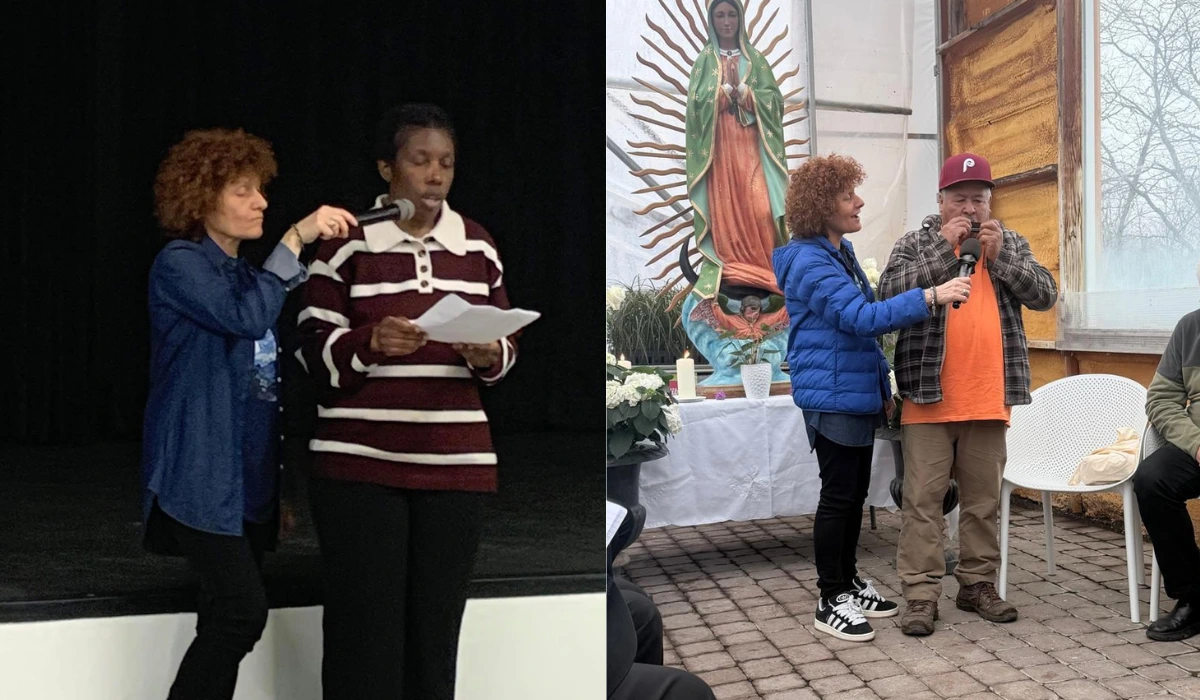
A Church in mission
Q.- What is your opinion on the work regarding migration of the Latin American Church?
A.- I have enormous admiration for that work. Celam and the episcopal conferences in the region have built truly remarkable networks for human mobility pastoral care, such as the Clamor Network, which accompanies migrants along the entire migration route, not just at the point of origin or destination.
I also think of the migrant houses throughout Mexico, which offer shelter, food, and protection to those crossing one of the most dangerous stretches of the continent.
Ese es un ejemplo de Iglesia en salida, una Iglesia que no espera a que las personas lleguen a la parroquia, sino que sale al camino, literalmente, para acompañar el sufrimiento humano. Documentos como los de Aparecida ya hablaban de la migración como un signo de los tiempos, y creo que la Iglesia latinoamericana ha sabido leer ese signo con mucha coherencia pastoral.
That is an example of a Church in mission, a Church that does not wait for people to arrive at the parish, but goes out on the road, literally, to accompany human suffering.
Respecting local processes
Q.- There is the right not to migrate, how can we promote integrationist policies in those expelling countries, where poverty abounds, without violating sovereignty?
A.- Yes, and I believe this is a point that is often forgotten. Pope Francis has explicitly spoken about the right not to emigrate, that is, the right of every person to find in their own country the dignified conditions to develop, without being forced to leave.
The key, and here is the delicate part, is to distinguish between cooperation and interference. Development processes in the expelling countries can be supported —responsible investment, fair trade, institutional strengthening, support for civil society, education, and health— without imposing external models.
This requires that cooperation be requested, respectful of local processes, and that it strengthens the local capacities of those countries instead of creating new dependencies. It is not about deciding for those countries, but about walking alongside them so that their citizens truly have the option to stay if they wish.

Prophetic vocation
Q.- How to manage and denounce the dictatorial regimes that violate human rights?
A.- The Church has a very strong tradition of prophetic denunciation. Let’s think of figures like Monsignor Óscar Romero, who gave his life to denounce structural violence in his country. That tradition is still alive today through human rights reports prepared by the episcopal conferences, joint work with international organizations like the UN or the OAS, and support for journalists and human rights defenders who often work in extremely risky conditions.
At the same time, it must be recognized that this requires a delicate balance: publicly denouncing without endangering the local communities that continue to live and work under those regimes.
Sometimes public denunciation is complemented by more discreet diplomatic efforts. But at its core, the mission does not change: the Church does not seek political prominence, it seeks to be the voice of those who have no voice, and that implies maintaining that prophetic vocation even when it becomes uncomfortable or risky.
Cover Photo: Alessandra Santopadre
Cover Photo: Alessandra Santopadre
You may be interested in:
Luis Enrique Ramos: Reclac wants to break the isolation and unite the voices of the Church in Latin America
Subscribe for free to our Whatsapp channel https://bit.ly/4hbWWN0
Discover the new 2026 offer of courses, diplomas, and degrees at Cebitepal https://bit.ly/4aHAue1
Because we must care for those who protect creation, the podcast Life Hangs by a Thread arrives https://bit.ly/46cGUiB
Luis Enrique Ramos: Reclac wants to break the isolation and unite the voices of the Church in Latin America
Subscribe for free to our Whatsapp channel https://bit.ly/4hbWWN0
Discover the new 2026 offer of courses, diplomas, and degrees at Cebitepal https://bit.ly/4aHAue1
Because we must care for those who protect creation, the podcast Life Hangs by a Thread arrives https://bit.ly/46cGUiB