The Ecclesial Communication Network of Latin America and the Caribbean (Reclac) is embarking on its formal journey with the challenge of bringing together the various communication initiatives of the Church in Latin America and the Caribbean. Its first secretary general, Luis Enrique Ramos Zapata of Puerto Rico, explained the objectives and challenges of this CELAM initiative in an interview with ESNE El Sembrador Nueva Evangelización.
Reclac seeks to connect the existing networks and communication initiatives within the Latin American and Caribbean Church. Ramos Zapata described it as a space for “encounter, coordination, and collaboration” that allows for the sharing of capabilities and the pooling of efforts among episcopal conferences, church organizations, dioceses, media outlets, and communities.
A “network of networks” to share experiences
Rather than creating new structures, RECLAC seeks to bring together the communication initiatives that already exist within the Latin American and Caribbean Church. Hence its commitment to becoming a “true network of networks” that allows us to “get to know one another, listen to one another, and connect with one another” in order to strengthen the mission of evangelization.
The First Assembly made it clear that, despite the diversity of contexts, many communication needs are common across different regions. The challenge now is to coordinate efforts that have so far been carried out independently. “We are often making great efforts, but in isolation,” Ramos Zapata noted.
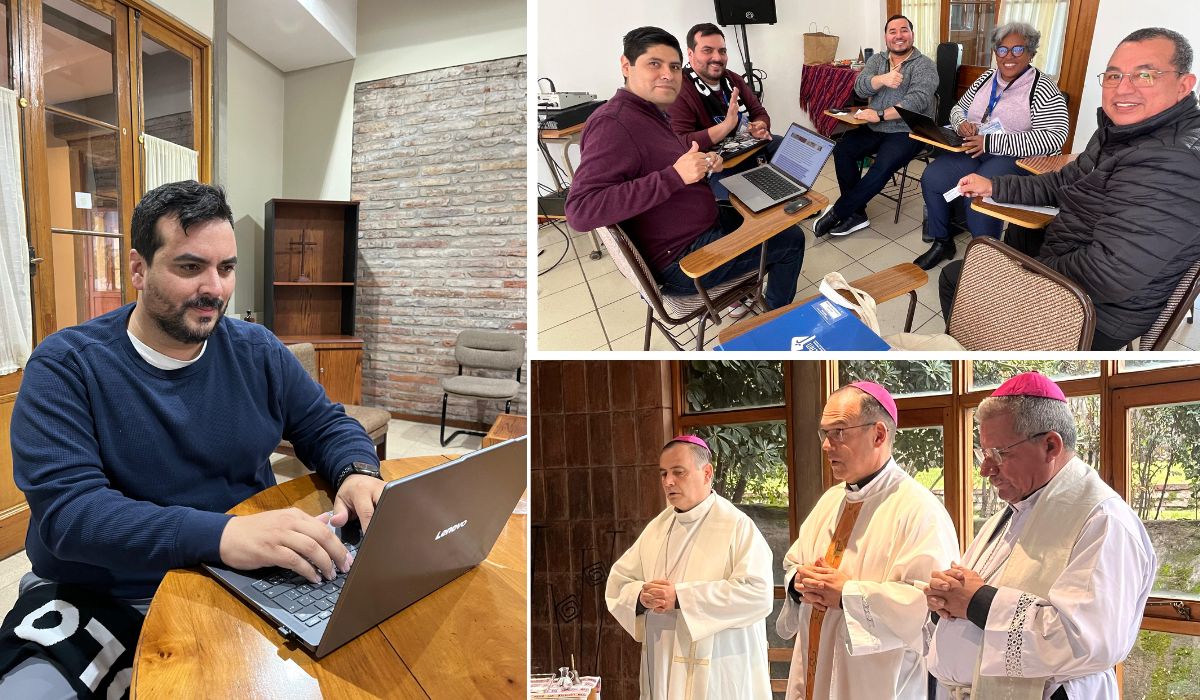
The regional organization of Reclac seeks to facilitate coordination among the different realities of the continent. To this end, the network is distributed across the Caribbean, Central America, Bolivarian, and Southern Cone regions, with a coordinator for each area, and also includes seven ecclesial organizations with voting rights. The purpose, said Ramos Zapata, is that this structure does not remain formal, but allows “to reach out to the needy, to those who need a voice”.
Training, artificial intelligence, and crisis communication
The first working groups have already begun to identify common challenges, including the training of communicators, artificial intelligence, crisis communication, and project funding. The goal is to share knowledge, experiences, and best practices so that one region’s strengths can serve as a resource for others.
The exchange of experiences thus emerges as one of RECLAC’s main strengths. Ramos Zapata explained that, while some regions have accumulated knowledge in crisis communication, others have more experience in project development and securing funding. “We began to identify the challenges” in order to recognize what each region can contribute, he noted.
Another challenge lies in integrating the region’s cultural and linguistic diversity. Spanish, Portuguese, French, and English coexist within a network that brings together very different ecclesial realities. In light of this, Ramos Zapata considers it essential to deepen mutual understanding in order to recognize the contribution of each conference and organization.

Una comunicación con Cristo en el centro
The Pope’s upcoming visit to the continent will also be an opportunity for RECLAC to begin putting its work as a network into practice. The episcopal conferences of Peru, Uruguay, and Argentina are already making progress in preparing for the meetings, while the new structure seeks to identify needs and pool resources from the various regions.
For Ramos Zapata, RECLAC will be meaningful only if communication remains linked to the mission of evangelization. For this reason, its purpose is not limited to coordinating institutional efforts or strengthening the Church’s presence on digital platforms. “We don’t want to build a network simply to improve institutional communication,” he noted, but rather to put that communication “at the service of evangelization.”

Jesus and the Gospel guide the path of Reclac
According to the official, this goal requires keeping Christ at the center of all communication. “We must keep Jesus at the center,” he said, noting that the Church’s communication is called to foster encounters, accompany those who suffer, and bring a message of hope.
In this regard, Ramos Zapata urged everyone not to lose sight of what gives meaning to the Church’s mission of communication: Jesus. “We must keep Jesus at the center,” he affirmed. From that perspective, communication should foster encounters and bring hope to those facing difficult situations.
The new network thus begins a process that will require time, coordination, and a willingness to listen among the various ecclesial realities. Ramos Zapata acknowledges that not all objectives can be achieved in the short term, but he is confident that they will “lay the groundwork” for a structure capable of responding to the challenges of communication without losing sight of what gives it meaning: the proclamation of the Gospel.
Subscribe for free to our Whatsapp channel https://bit.ly/4hbWWN0
Discover the new 2026 offer of courses, diplomas, and degrees at Cebitepal https://bit.ly/4aHAue1
Because we must care for those who protect creation, the podcast Life Hangs by a Thread arrives https://bit.ly/46cGUiB